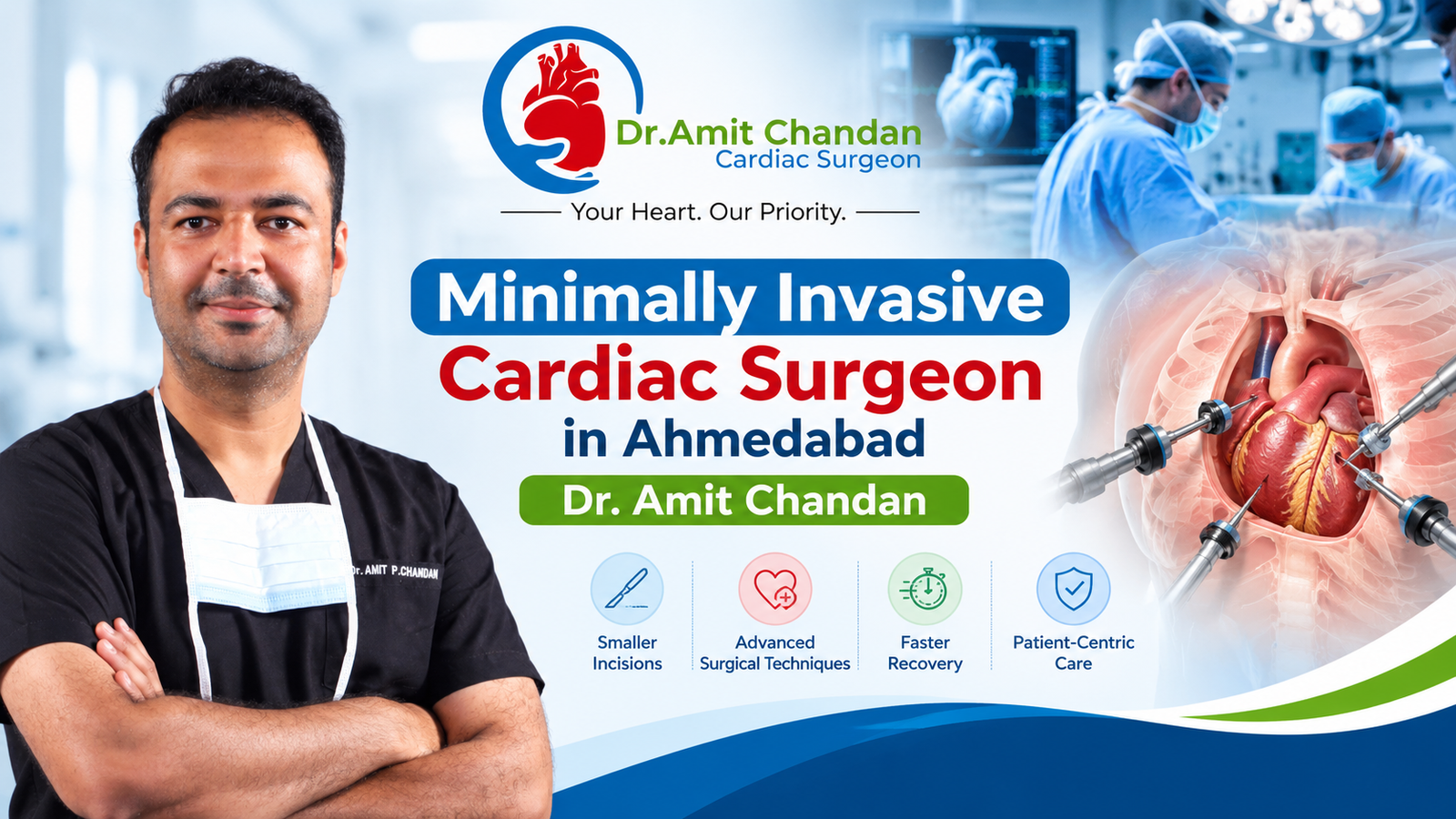
When a patient is diagnosed with a heart condition that may require surgery, questions about treatment options, recovery, surgical risks, and long-term heart health are natural. Advances in cardiac surgery have made it possible to treat certain heart conditions through smaller surgical incisions using specialized techniques.
Minimally invasive cardiac surgery (MICS) is an approach used for selected heart procedures. Depending on the patient’s condition and the procedure required, it may offer benefits such as smaller incisions and a different recovery experience compared with conventional surgical approaches.
For patients searching for a minimally invasive cardiac surgeon in Ahmedabad, it is important to understand how these procedures work, which patients may be suitable, and what factors matter when choosing a surgeon.
Dr. Amit Chandan is a Consultant Cardiothoracic and Vascular Surgeon in Ahmedabad whose professional profile lists minimally invasive cardiac surgery, CABG, valve repair and replacement, and other advanced cardiac procedures among his areas of expertise.
What Is Minimally Invasive Cardiac Surgery?
Minimally invasive cardiac surgery is a surgical approach that uses smaller incisions or specialized access techniques for selected procedures involving the heart.
In conventional open-heart surgery, certain procedures require an incision through the breastbone to access the heart. Depending on the operation, minimally invasive techniques may allow the surgeon to reach the heart through smaller incisions between the ribs or through other specialized surgical access points.
The exact technique depends on the heart condition being treated and the procedure planned.
Minimally invasive cardiac surgery may be considered for selected procedures involving:
- Coronary artery bypass grafting (CABG)
- Mitral valve repair or replacement
- Aortic valve replacement
- Atrial septal defect (ASD) repair
- Certain procedures for atrial fibrillation
- Certain cardiac tumors
- Other appropriate cardiac conditions
Not every heart condition can be treated using a minimally invasive approach. A detailed clinical evaluation is necessary to determine whether it is suitable for an individual patient.
What Does a Minimally Invasive Cardiac Surgeon Do?
A minimally invasive cardiac surgeon evaluates heart conditions that may require surgery and determines whether a smaller-incision approach is appropriate.
The surgeon reviews diagnostic reports, medical history, heart function, anatomy, previous procedures, and other health conditions before recommending a surgical plan.
The responsibilities may include:
- Assessing the patient’s heart condition
- Reviewing echocardiography, CT, angiography, and other relevant reports
- Explaining conventional and minimally invasive treatment options
- Determining whether a minimally invasive procedure is suitable
- Performing the recommended cardiac surgery
- Coordinating care with cardiologists, anaesthesiologists, and other specialists
- Monitoring the patient’s progress after surgery
- Providing guidance regarding recovery and follow-up
The main goal is to select an appropriate treatment approach for the patient’s condition rather than choosing a technique solely because it uses smaller incisions.
Potential Benefits of Minimally Invasive Cardiac Surgery
For appropriately selected patients, minimally invasive cardiac surgery may offer advantages compared with some conventional surgical approaches.
Potential benefits can include:
Smaller Surgical Incisions
Smaller incisions may reduce the size of the surgical scar. The exact incision and cosmetic outcome depend on the procedure and the patient’s healing.
Potentially Less Surgical Trauma
Some minimally invasive approaches avoid a full breastbone incision and may involve less disruption of surrounding tissues. The degree of tissue disruption varies by procedure.
Postoperative Comfort
Some patients may experience less postoperative discomfort, depending on the operation and surgical approach.
Recovery and Hospital Stay
Selected minimally invasive procedures may be associated with shorter hospital stays or a different recovery timeline. However, recovery depends on the type of surgery, overall health, and whether complications occur.
Return to Daily Activities
Some patients may be able to resume certain activities earlier after selected minimally invasive procedures. The treating team will advise when it is safe to return to work, exercise, driving, and other daily activities.
Important: These are potential benefits, not guaranteed outcomes. Minimally invasive cardiac surgery is not necessarily safer or better for every patient, and the appropriate approach depends on individual clinical circumstances.
Types of Minimally Invasive Cardiac Surgery
Different minimally invasive techniques are used for different heart conditions. The choice depends on the patient’s diagnosis, anatomy, and surgical requirements.
1. Minimally Invasive Coronary Artery Bypass Surgery
Coronary artery bypass grafting, commonly called CABG or heart bypass surgery, is used to improve blood flow to the heart muscle when coronary arteries are significantly narrowed or blocked.
In selected patients, minimally invasive CABG can be performed through smaller surgical access points rather than the larger incision used in some conventional procedures.
The surgeon evaluates the number and location of coronary artery blockages, the patient’s overall health, and the complexity of the procedure before deciding whether minimally invasive bypass surgery is appropriate.
2. Minimally Invasive Heart Valve Surgery
Heart valve disease can affect the way blood flows through the heart. Depending on the condition, treatment may involve repairing or replacing an affected valve.
Selected mitral valve and other valve procedures may be performed using minimally invasive techniques.
The choice between repair and replacement, as well as the surgical access method, depends on the valve condition, anatomy, severity of disease, and the patient’s overall health.
3. Robotic-Assisted Cardiac Surgery
Robotic-assisted cardiac surgery is an advanced approach used for selected procedures. The surgeon controls specialized instruments through a robotic system while viewing the surgical area using enhanced visualization.
Robotic technology may support precise instrument movements and smaller surgical access for appropriate procedures.
However, robotic cardiac surgery is not suitable for every patient or every heart condition. The surgeon must assess whether the technology offers a suitable approach for the procedure being considered.
4. Minimally Invasive Procedures for Selected Structural Heart Conditions
Certain structural conditions, including selected atrial septal defects, may be treated surgically using specialized techniques.
The treatment approach depends on the location and size of the defect, associated heart problems, and the patient’s clinical assessment. Some patients may be candidates for catheter-based treatment rather than surgery.
A specialist evaluation helps determine the most appropriate option.
Who May Be Suitable for Minimally Invasive Heart Surgery?
Minimally invasive cardiac surgery may be appropriate for patients who require certain heart procedures and meet the clinical criteria for the technique.
Suitability depends on several factors, including:
- The type and severity of heart disease
- The location and anatomy of the affected structures
- Coronary artery anatomy, when bypass surgery is being considered
- Heart function
- Previous heart or chest surgery
- Other medical conditions
- The complexity of the required operation
- The patient’s overall surgical risk
For some patients, conventional cardiac surgery may provide the more appropriate treatment. Others may be suitable for minimally invasive or robotic-assisted procedures.
The decision should be made after reviewing the patient’s reports and discussing the available options with the cardiac surgical team.
Minimally Invasive Cardiac Surgery vs Conventional Open-Heart Surgery
Patients often ask whether minimally invasive cardiac surgery is better than conventional open-heart surgery.
There is no single answer that applies to everyone.
Minimally invasive surgery uses smaller access points for selected procedures. Conventional surgery may involve a larger incision and, in some operations, opening the breastbone to access the heart.
The differences depend on the procedure being performed.
| Factor | Minimally Invasive Approach | Conventional Approach |
| Surgical access | Smaller incisions for selected procedures | May involve a larger incision |
| Breastbone incision | May be avoided, depending on the procedure | May be required for certain operations |
| Recovery | May differ or be shorter for selected patients | Depends on the operation and recovery progress |
| Suitability | Depends on anatomy and clinical factors | May be preferable for some complex conditions |
| Surgical planning | Requires procedure-specific assessment | Also requires individualized assessment |
Patients should not choose a procedure based on incision size alone. The primary consideration is which surgical approach can appropriately treat the heart condition.
How to Choose a Minimally Invasive Cardiac Surgeon in Ahmedabad
Choosing a cardiac surgeon is an important step when surgery has been recommended. Patients can consider several factors when evaluating a specialist.
Specialist Qualifications
Check the surgeon’s qualifications and training in cardiothoracic or cardiovascular surgery.
Experience With the Required Procedure
Experience with the specific procedure matters. A surgeon’s experience with minimally invasive CABG may differ from experience with minimally invasive valve surgery or robotic cardiac surgery.
Ask about the approach being recommended for your particular condition.
Hospital Facilities and Team Support
Cardiac surgery involves more than the surgeon alone. Anaesthesia, intensive care, nursing, perfusion, and other specialist services may be required depending on the operation.
Consider the facilities and multidisciplinary support available at the hospital.
Clear Communication
The surgeon should explain the diagnosis, treatment options, potential benefits, possible risks, and expected recovery in language that the patient can understand.
Individualized Treatment Planning
The best surgical approach is the one that fits the patient’s medical needs. A specialist should explain why a particular technique is being recommended and whether alternatives are appropriate.
What Happens Before Minimally Invasive Cardiac Surgery?
Before surgery, the cardiac team evaluates the patient’s condition and plans the procedure.
Depending on the diagnosis, the evaluation may include:
- Medical history and physical examination
- Echocardiography
- ECG
- Coronary angiography or CT imaging, when indicated
- Blood tests
- Assessment of heart function
- Review of medications and other medical conditions
- Pre-anaesthesia evaluation
Not every patient requires every test. The investigations depend on the condition and the planned operation.
Patients should share their complete medical history and current medication list with the treating team. They should not stop prescribed medicines unless instructed by their clinician.
Recovery After Minimally Invasive Cardiac Surgery
Recovery after minimally invasive cardiac surgery varies according to the procedure and the patient’s overall health.
The initial recovery period may involve hospital monitoring, pain management, breathing exercises, gradual movement, wound care, and assessment of heart function.
After discharge, patients may need to:
- Take prescribed medicines as directed
- Follow wound-care instructions
- Increase physical activity gradually
- Attend follow-up appointments
- Follow restrictions on lifting, driving, and exercise
- Perform prescribed breathing exercises as advised by the surgeon
- Participate in cardiac rehabilitation if recommended
- Follow dietary and lifestyle guidance
Some patients recover more quickly after selected minimally invasive procedures, but others may require a longer recovery period.
The surgeon and care team should provide an individualized recovery plan. Patients should seek medical advice if they develop concerning symptoms or have questions about their recovery.
Why Follow-Up Care Matters
Cardiac surgery is one part of the broader treatment journey. Follow-up care helps the medical team monitor recovery and address ongoing cardiovascular risks.
Depending on the condition, long-term care may involve medication, blood pressure and cholesterol management, diabetes control, smoking cessation, physical activity, and cardiac rehabilitation.
Patients should continue recommended follow-up even if they feel well after surgery. Minimally invasive surgery does not remove the need to manage the underlying heart condition.
Conclusion
Minimally invasive cardiac surgery has expanded treatment options for selected patients with heart conditions. Smaller surgical access may offer potential advantages, including smaller incisions and a different recovery experience, but the right approach depends on the diagnosis, anatomy, procedure, and overall health.
For patients searching for a minimally invasive cardiac surgeon in Ahmedabad, it is important to consider specialist qualifications, procedure-specific experience, hospital support, and the quality of communication throughout care.
Dr. Amit Chandan is a Consultant Cardiothoracic and Vascular Surgeon in Ahmedabad whose listed areas of practice include minimally invasive cardiac surgery, CABG, valve surgery, aortic surgery, and other advanced cardiac procedures.
The most important step is to obtain an appropriate clinical evaluation and discuss the available treatment options with a qualified cardiac surgical team. Every treatment decision should be based on the patient’s individual needs, potential risks, and expected benefits.
Minimally invasive cardiac surgery is an established option for selected procedures and patients. Like all heart surgery, it carries risks. Safety and suitability depend on the patient’s condition, the procedure, the surgical team, and the available hospital facilities.
It may result in a different or shorter recovery for selected patients, but faster recovery is not guaranteed. The recovery timeline depends on the procedure, general health, and whether complications occur.
Dr. Amit Chandan’s professional profile at Marengo CIMS Hospital lists minimally invasive cardiac surgery, including selected CABG and valve procedures, among his areas of practice. Patients can consult the official profile and contact the hospital to discuss their individual treatment needs.